
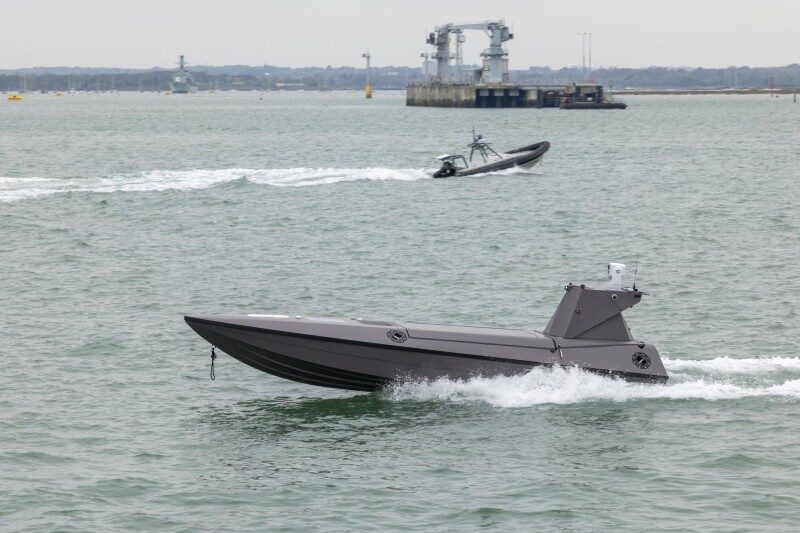
Britain’s Royal Navy has formally commissioned its first uncrewed boat squadron, operating seaborne drones on front-line operations as part of its “Hybrid Navy” strategy.
The force says the 1st Autonomous Squadron officially entered active service on November 5 at a ceremony in Portsmouth Naval Base. It comprises around 180 personnel, about the same as a Type 23 frigate, split into two watches to enable operations around the clock.
This active squadron replaces Project Beehive, the navy’s experimental program to build a fleet of autonomous and remotely operated vessels, through which it obtained 20 uncrewed boats from UK-based Kraken Technology Group.
The force is understood to be using both Kraken’s K3 Scout, and the SM400 from SYOS Aerospace, known by the Royal Navy as the Rattler.
The K3 Scout is an 8.4 m boat capable of 55 knots and can carry a payload of up to 600 kg. It has a range of up to 650 nautical miles and endurance of up to 7 days. The maker describes it as capable of a range of missions, including anti-ship and anti-submarine to detecting and countering other drones and even casualty evacuation.
The Rattler boat is 7.2 m and has a 500 kg modular bay, with a range of up to 950 nautical miles. It was used last year in a demonstration during which 5 of the uncrewed boats were remotely-piloted to escort patrol ship HMS Tyne and mine countermeasures mothership HMS Stirling Castle
Part of the new squadron’s mission will be to act as pathfinder for drone operations, working on bringing additional types of uncrewed surface vessel (USVs) into fleet service and conducting a range of operations alongside other organizations – both as single vessels and as part of a task group.
The “Hybrid Navy” concept was outlined by First Sea Lord General Sir Gwyn Jenkins earlier this year, who made the case that uncrewed vessels would be vital in filling the gaps left by the Royal Navy’s much depleted surface fleet.
Speaking at the launch of the autonomous squadron, Fleet Commander Vice-Admiral Steve Moorhouse hailed it as an historic occasion, but warned that the seas are becoming more contested, more dangerous and harder to operate in.
“A hybrid navy is about giving our people better tools. It means more reach, more striking power and more options,” he stated.
Last week, the force also launched strike drones from one of its aircraft carriers for the first time. Nyan one-way drones made by BAE Systems were launched from the deck, as well as a Tekever AR5 fixed-wing uncrewed aircraft, the same kind the British Army has selected to replace its troublesome Watchkeeper fleet.
Elsewhere, the Ministry of Defence (MoD) says it has launched a British-built satellite called Titania into orbit, claiming it “gives the Armed Forces a new pair of eyes in space.” However, the original purpose of the orbiter was understood to be to test high-speed optical communications from low Earth orbit directly to Earth, using laser beams that are harder to intercept than radio links.
Titania is the second satellite in the UK’s growing constellation of military satellites in orbit, following the launch of Tyche in October, and will be operated by UK Space Command as part of the ISTARI* program.
The latter aims to deliver satellites and supporting ground systems to expand space-based intelligence, surveillance and reconnaissance, the MoD said.
However, while the satellite is British-made, it got into space via an American rocket, riding on SpaceX’s Transporter-18 mission. ®
* What is it with the tech industry and Tolkien references?


